In-Home Personal Training · Plainview, NY · Adults 55+
Personal Trainer for Adults 55+
One-on-one strength, balance and mobility coaching in your own home — built for your joints, your health history and your pace. No gym, no commute, no equipment to buy.
Hannah, NSCA-CPT since 2008Plainview & central Nassau CountyUpdated 16 September 2026
19+Years coaching
55+Specialist focus
34%Fall-rate reduction from balance, functional & strength work2
Hannah is an NSCA-certified personal trainer serving Plainview, NY who specialises in adults 55 and older. Sessions are one-on-one and in your own home. Programmes focus on strength, balance, mobility and confidence rather than aesthetics, progress gradually from bodyweight movements, and work around arthritis, joint replacements and past surgeries. Rates start at $130 per session, and most clients train two to three times a week.
Why work with a personal trainer in Plainview after 55?
Muscle mass declines with age. Adults begin losing it gradually in their thirties and forties, and the Cleveland Clinic puts the rate at as much as 8% per decade, with the loss accelerating between 65 and 80.5 That decline — sarcopenia — is what makes rising from a chair, carrying groceries, climbing stairs and catching yourself after a stumble feel harder each year.
40sbaseline
50s−8%
60s−15%
70s−22%
Illustrative, at the upper end of the rate the Cleveland Clinic reports for untrained adults.5 Individual rates vary considerably.
The reassuring part is that this is not a one-way street. Resistance training rebuilds muscle and strength well into later life — the National Strength and Conditioning Association's position statement documents improvements in adults aged 85 and over.4 The goal isn't to look 25. It's to stay independent, steady and confident for the next two or three decades.
The evidence
What actually reduces falls
More than one in four older adults in the United States falls each year, and falling once roughly doubles the chance of falling again.3 It's the clearest reason to train after 55 — and the effect of exercise on it has been measured precisely.
Reduction in the rate of falls
Cochrane review, 108 trials, 23,407 participants2
Any exercise programme−23%
Across all exercise types pooled together.
Balance & functional exercises−24%
High-certainty evidence — the strongest single category.
Moderate-certainty evidence — combining the three outperforms any one alone.
This is why 55+ sessions are never just lifting. Every session mixes resistance work with balance drills and real-life movement patterns — the combination with the best evidence behind it.
Worth knowing
The same review found that programmes built primarily around resistance training alone, or around walking or dance alone, did not show sufficient evidence of reducing falls. The balance and functional components are doing real work — they are not a warm-up.
Sherrington et al. (2019), Cochrane Database of Systematic Reviews, CD012424.2
The weekly target
What the guidelines ask of adults 65 and older
The CDC sets three requirements for older adults — and unlike the guidance for younger adults, balance is called out explicitly as its own category.1
Aerobic150 min / week
Moderate intensity, or 75 minutes vigorous, or an equivalent mix. Walking counts.
Muscle-strengthening2+ days / week
All major muscle groups. This is the half most adults skip entirely.
BalanceSpecific to 65+
Activities that challenge stability — heel-to-toe walking, standing from seated.
Two to three in-home sessions a week clears the strength requirement outright, builds the balance work into every session, and contributes to the aerobic total through paced circuits.
Choosing well
Five questions to ask any Plainview trainer
Training a 62-year-old with a prior hip replacement is a different job from training a college athlete. These are the questions that separate the two.
What's your experience with clients my age?
You want someone who trains older adults routinely, not occasionally. Ask what proportion of their clients are over 55.
How will you account for my health conditions?
Arthritis, blood pressure, osteoporosis, past surgeries and medications should all shape the plan before a single exercise is prescribed.
Do you assess before you programme?
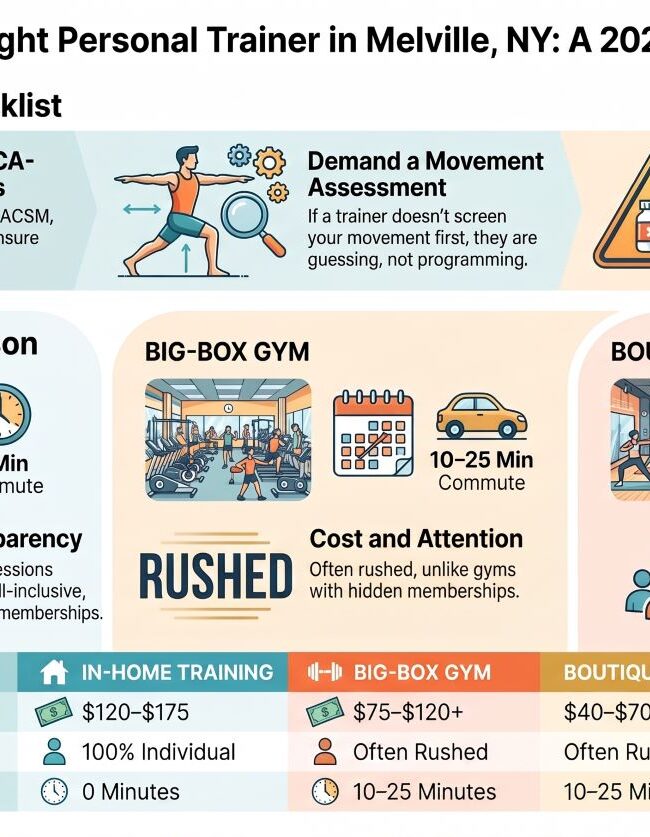
The answer should be yes, every time — balance, gait, chair rise, grip and joint range, documented at the start.
Where and how do sessions happen?
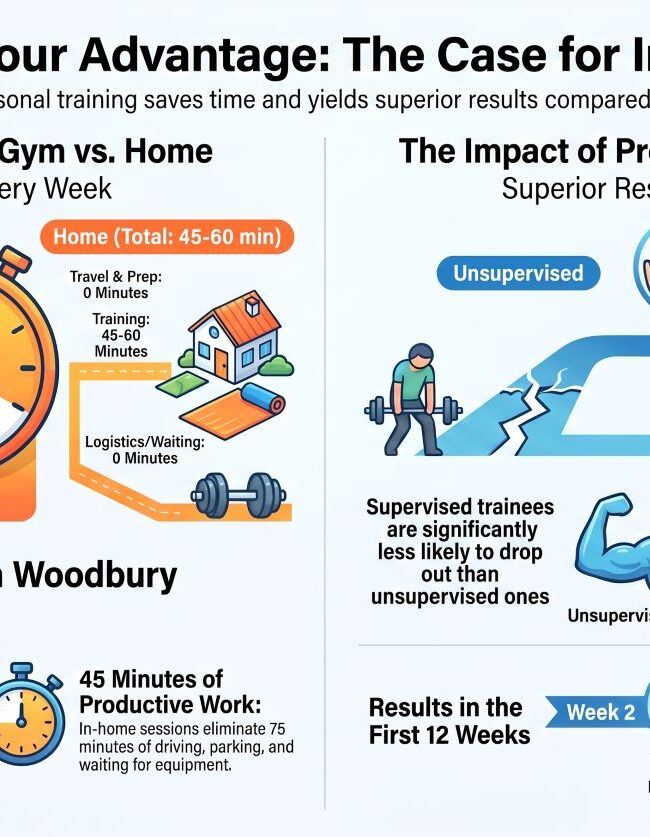
In-home training removes the drive, the parking, the unfamiliar machines and the self-consciousness in one move.
How will we measure progress?
Look for functional markers — easier stairs, steadier balance, getting off the floor unaided — not just a number on a scale.
Hannah holds the NSCA-CPT credential — the National Strength and Conditioning Association is the body that authored the older-adult resistance training position statement cited on this page. More about Hannah, or explore the senior fitness programme.
The comparison
In-home training vs. the gym after 55
For a lot of Plainview adults the gym is more obstacle than benefit. One-on-one in-home training removes most of the friction points at once.
Crowded gym / group class
In-home, one-on-one
Attention on your form
Shared across a whole room.
Every single rep, watched and corrected.
Programme design
One routine for the whole class.
Built around your body and history.
Getting there
Drive, park, wait for equipment.
Hannah comes to you.
Comfort level
Can feel intimidating or rushed.
Familiar, private, unhurried.
Working around conditions
Rarely accommodated.
Central to the plan from day one.
There is also evidence that supervision itself changes outcomes: a 2023 randomised trial found supervised trainees made greater strength and muscle gains than unsupervised ones, and were far more likely to still be training at the end of the programme.6
Every client starts with a movement and health assessment — how you rise from a chair, your balance, your walking stride, grip strength, and any joint limitations or past injuries. From there each session follows the same shape.
Step 1
Warm-up & mobility. Gentle movement to prepare the joints and raise core temperature.
Step 2
Strength work. Scaled to your level — bodyweight and bands first, light dumbbells as you progress.
Step 3
Balance & stability. The drills with the strongest evidence against trips and falls.
Step 4
Functional practice. Standing, carrying, reaching, and getting up from the floor.
Step 5
Cool-down & recap. Stretching, plus what to work on before next time.
See the full in-home training experience
A closer look at how sessions run, what equipment arrives, and how programmes progress.
Farmingdale & Muttontown — in-home strength and balance work
Old Bethpage & Hicksville — across the central Nassau corridor
Bethpage — early-morning and mid-day availability
Questions
Frequently asked questions
Do you offer personal training in Plainview?
Yes. Hannah is a personal trainer serving Plainview, NY with in-home, one-on-one sessions. She also trains clients in Syosset, Woodbury, Jericho, Melville, Farmingdale, Muttontown, Old Bethpage and Hicksville.
How much does a personal trainer cost in Plainview?
Hannah's in-home sessions start at $130 per session. The right frequency — usually two to three sessions a week to begin with — is recommended during your first consultation based on your goals and starting point.
Do you specialise in older adults and seniors?
Yes. Hannah's practice focuses on adults 55 and older, with programmes built around strength, balance, mobility and independence. Many clients are in their 60s, 70s and 80s.
Do I need a gym membership or any equipment?
No. Hannah brings the equipment and trains you in your own home, so there's no gym, no commute and no gear to buy. Programmes start with bodyweight movements and light resistance, then progress from there. A clear space of about 6 × 8 feet is enough.
Is it safe to start training at 55, 65 or 75 with health conditions?
For most people, supervised strength training is both safe and beneficial at any age when properly programmed. The NSCA's position statement documents benefits in adults over 85.4 Hannah works around arthritis, prior surgeries, joint replacements and other conditions. Always check with your physician before starting a new exercise programme.
How often should someone over 55 train?
The CDC recommends muscle-strengthening activity on two or more days per week, plus balance activities for adults 65 and older, alongside 150 minutes of moderate aerobic activity.1 Hannah typically starts clients at two to three sessions per week.
Will training actually reduce my risk of falling?
The evidence is strong. A Cochrane review of 108 trials found exercise reduced the rate of falls by 23% overall, rising to 34% for programmes combining balance, functional and resistance work — the combination Hannah programmes.2 No programme eliminates risk entirely.
What if I haven't exercised in twenty years?
That's the typical starting point, not the exception. Every programme opens with an assessment and begins below what you can already do, so the first sessions build confidence rather than soreness.
What are your hours, and what's the cancellation policy?
Monday to Friday 6 AM–6 PM and Saturday 7 AM–12 PM; Sunday closed. Mid-morning slots are popular with retired clients. Cancellations need 24 hours' notice; late cancellations are subject to a fee.
How do I get started?
Book a consultation online or call 516-254-9873. Hannah will talk through your goals and health history, then schedule an initial assessment before building your programme.
Getting started
Stronger and steadier, starting at home
The decline is real, and so is the response to training. Two sessions a week, progressed sensibly, is enough to change how the stairs feel within a couple of months.
Book your free consultation
A 15-minute conversation about your goals, your health history and your schedule. No obligation, no pressure.
Sherrington C, Fairhall NJ, Wallbank GK, Tiedemann A, Michaleff ZA, Howard K, Clemson L, Hopewell S, Lamb SE. Exercise for preventing falls in older people living in the community.Cochrane Database of Systematic Reviews, 2019, Issue 1, Art. No. CD012424. doi.org/10.1002/14651858.CD012424.pub2
Fragala MS, Cadore EL, Dorgo S, Izquierdo M, Kraemer WJ, Peterson MD, Ryan ED. Resistance Training for Older Adults: Position Statement From the National Strength and Conditioning Association.Journal of Strength and Conditioning Research, 2019;33(8):2019–2052. nsca.com
Coleman M, Burke R, Benavente C, Piñero A, Augustin F, Maldonado J, Fisher JP, Oberlin D, Vigotsky AD, Schoenfeld BJ. Supervision during resistance training positively influences muscular adaptations in resistance-trained individuals.Journal of Sports Sciences, 2023;41(12):1207–1217. doi.org/10.1080/02640414.2023.2261090
Medical disclaimer. This page is general educational information, not medical advice, diagnosis or treatment. Always consult your physician or qualified healthcare provider before beginning a new exercise programme — particularly if you are over 55, or have an existing medical condition, recent injury or surgery, cardiovascular disease, diabetes or osteoporosis, or take medications that affect balance or blood pressure. Hannah Personal Trainer is not a medical professional. Individual results vary with age, health status and adherence, and no exercise programme eliminates the risk of falls or injury entirely.
Lorem ipsum dolor sit amet, consectetur
adipiscing elit. Pellentesque vitae nunc ut
dolor sagittis euismod eget sit amet erat.
Mauris porta. Lorem ipsum dolor.