
How Strength Training After 60 Prevents Falls and Builds Independence
For Plainview adults entering their 60s, 70s, and beyond, the conversation about fitness shifts. It’s no longer about shrinking a waistline or chasing a marathon PR. It’s about something more important — staying strong, balanced, and independent for the next two or three decades of life. The single most effective tool for achieving that goal isn’t a new medication or supplement. It’s strength training.
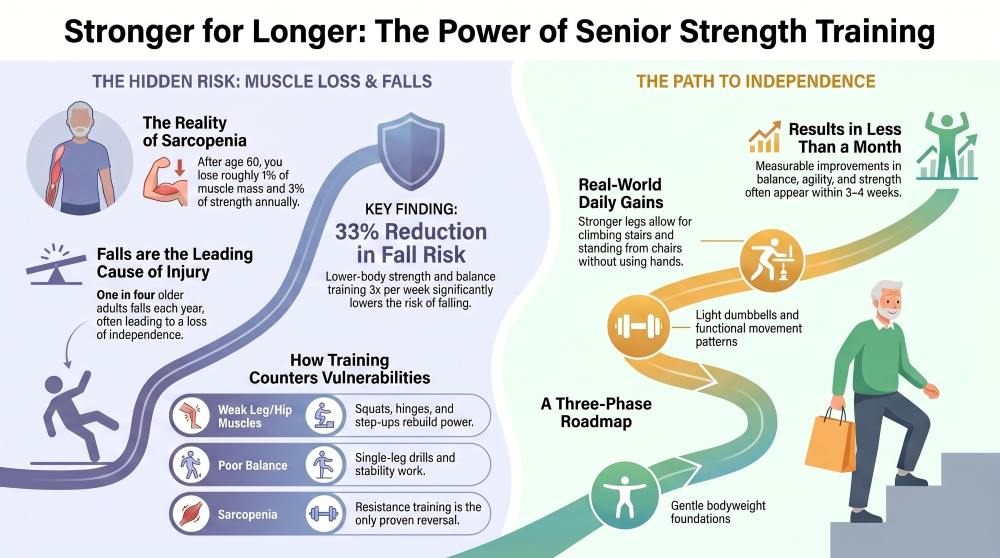
According to the Centers for Disease Control and Prevention (CDC), falls are the leading cause of injury-related death among adults 65 and older, and one in four older adults experiences a fall each year. Even more striking: research published by the CDC shows that lower-body strength and balance training performed three times per week can reduce fall risk by approximately 33% — a life-changing improvement.
As a senior fitness specialist serving Plainview and surrounding communities, Hannah designs in-home strength programs specifically for adults 60+ who want to keep doing the things they love — gardening, golfing, traveling, playing with grandchildren — without the constant worry of falling or losing independence.
Why Strength Training Matters More After 60
Most Plainview adults know that exercise is good for them. What many don’t realize is that not all exercise is created equal — and after age 60, walking alone is not enough to protect against the changes happening in your body.
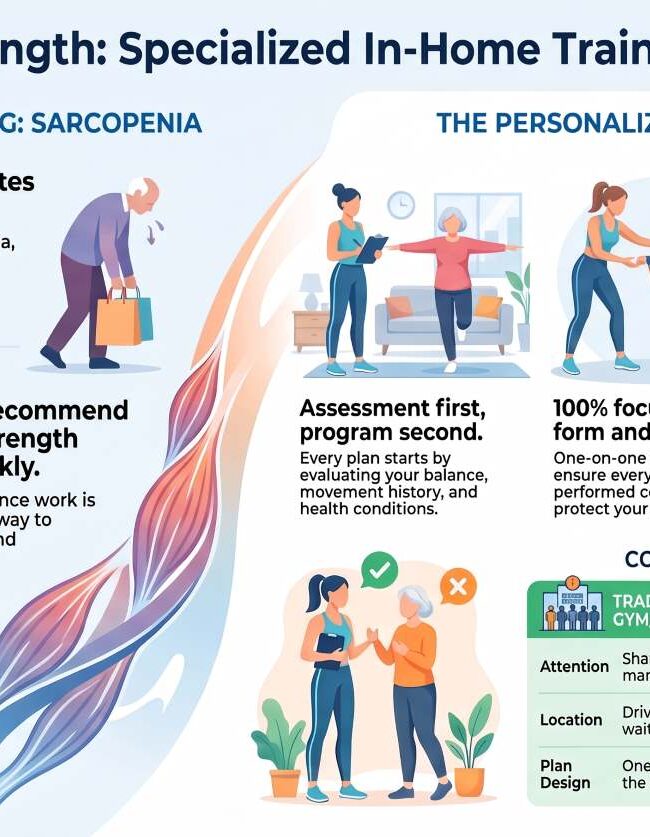
Here’s the biological reality: starting around age 30, adults lose approximately 3–5% of muscle mass per decade. After age 60, that loss accelerates — and research published by the National Institutes of Health shows muscle loss of about 1% per year and strength loss at roughly 3% per year. This progressive condition is called sarcopenia, and it directly affects your ability to stand up from a chair, climb stairs, carry groceries, and catch yourself if you stumble.
Reduction in fall risk for older adults doing challenging lower-body strength & balance training 3x per week (CDC research)
The fix isn’t more cardio. It’s progressive resistance training — controlled, supervised strength work that rebuilds the muscle, power, and coordination that aging gradually takes away. The good news: research from the American Council on Exercise (ACE) found that even adults in their 70s can see significant improvements in balance, agility, strength, and endurance in less than one month of functional strength training.
The Real-World Benefits of Senior Strength Training
This isn’t about lifting heavy barbells or bodybuilding. Hannah’s senior strength programs are gentle, joint-friendly, and progressively scaled to your current ability. The benefits show up in your everyday life within weeks:
- 🦵Stronger legs & hips — climb stairs without pausing, stand up from a chair without using your hands
- ⚖️Better balance & coordination — catch yourself if you stumble, walk confidently on uneven ground
- 🦴Improved bone density — resistance training stimulates bone-building, reducing fracture risk
- 🚶Steadier gait — research consistently shows strength training improves walking speed and stability
- 💪Easier daily tasks — carrying groceries, lifting grandchildren, gardening, opening jars
- 🧠Sharper mind — exercise is linked to improved cognitive function and brain health in older adults
- 😊Better mood & confidence — feeling strong reduces fear of falling and increases independence
- 💤Improved sleep — strength training supports deeper, more restorative rest
What Falls Actually Cost — and Why Prevention Matters
Falls aren’t just a statistic — they’re often the moment when independence ends. For many Plainview seniors, a single fall leads to a fractured hip, a hospital stay, weeks of rehab, and sometimes a permanent loss of the ability to live alone. The CDC notes that fall-related injuries are a leading reason older adults transition from independent living to assisted care.
Most falls happen due to a combination of factors — and strength training addresses nearly all of them:
| Risk Factor | What Strength Training Addresses |
|---|---|
| Weak leg & hip muscles | ✅ Directly trained with squats, hinges, step-ups, lunges |
| Poor balance | ✅ Single-leg work & dynamic stability drills |
| Slow reaction time | ✅ Power-based movement protects against trips |
| Reduced flexibility | ✅ Built-in mobility & range-of-motion work |
| Fear of falling | ✅ Confidence builds as strength returns |
| Sarcopenia (muscle loss) | ✅ Resistance training is the only proven reversal |
| OVERALL FALL RISK | ~33% reduction with consistent training (CDC) |
Worried About Falling? You Don’t Have to Be.
Hannah’s senior fitness program is designed specifically to address the muscle weakness, balance issues, and confidence loss that lead to falls — built around your current ability, not someone else’s.
What Hannah’s Senior Fitness Program Includes
Every program starts with a comprehensive movement assessment — Hannah evaluates how you stand up from a chair, your balance with eyes open and closed, your walking stride, your grip strength, and any joint limitations or past injuries. From there, she builds a customized program that progresses gently but consistently:
Phase 1: Foundation (Weeks 1–4)
- Gentle bodyweight movements — sit-to-stands, wall push-ups, supported squats
- Light resistance bands for upper body strength
- Basic balance work — heel-to-toe walking, single-leg holds with support
- Joint mobility plus breathing & posture work
Phase 2: Build (Weeks 5–10)
- Light dumbbells introduced — typically 3–8 lbs to start
- Step-ups, controlled lunges, and weighted carries
- Dynamic balance — reaching, turning, single-leg challenges
- Core strength (modified planks, bird dogs) and light resistance rows
Phase 3: Progress (Weeks 11+)
- Progressive overload — slightly heavier weights as strength builds
- Functional patterns — getting up from the floor safely, recovery from a stumble
- Continued balance challenges and mobility maintenance
- Long-term sustainability — habits that last decades, not weeks
Why In-Home Senior Training Beats the Gym
For most Plainview seniors, driving to a gym, navigating parking, then trying to figure out unfamiliar equipment is more obstacle than benefit. Group gym classes often move too quickly and don’t account for older joints or individual needs. In-home senior training solves every one of these problems:
- 🏠Train in your familiar environment — no anxiety about unfamiliar spaces or equipment
- 🚗No driving required — Hannah comes to you, with all equipment
- 👁️Constant supervision — every movement coached for safety and form
- 📋Programs built around YOUR needs — accounting for arthritis, prior surgeries, hip replacements, or heart conditions
- ⏰Flexible scheduling — morning, midday, or afternoon — whatever fits your routine
- 🤝Real human accountability — Hannah notices when something feels off, celebrates your wins, adjusts as you progress
5 Signs You’d Benefit from Senior Strength Training
- You hesitate before stairs. If climbing or descending stairs feels uncertain — or you’ve started avoiding them — your leg strength and balance need attention.
- You use your hands to stand up. If you push off the armrests or your knees to rise from a chair, that’s a clear marker of declining lower-body strength.
- You’ve had a recent fall or near-miss. Even one stumble that surprised you is a signal that reaction time, balance, or strength is dropping.
- You’ve stopped doing activities you used to enjoy. Hiking, gardening, dancing, traveling — if you’re avoiding them because they feel “risky,” strength training can change that.
- Your doctor mentioned bone density, balance, or fall risk. Strength training is one of the most evidence-backed interventions for all three.
Senior Fitness in Plainview & Surrounding Towns
Hannah serves seniors and active older adults across the area with in-home training:
- 📍Plainview — active retirees and adults preparing for retirement
- 📍Syosset, Woodbury, Muttontown — high-income retirees focused on quality-of-life longevity
- 📍Jericho, Melville, Farmingdale — empty-nesters reclaiming their fitness after years of putting family first
Frequently Asked Questions
1. Is strength training safe for someone over 70?
Yes — when properly programmed and supervised. Hannah designs programs specifically for older adults, accounting for joint health, blood pressure, prior injuries, and medications. Many of her clients are in their 70s and 80s and getting stronger every month.
2. I haven’t exercised in years. Is it too late to start?
It is never too late. Research consistently shows that adults who begin strength training in their 70s, 80s, and even 90s see meaningful improvements in strength, balance, and quality of life. The first session is just a starting point — and the body responds at any age.
3. What if I have arthritis, a prior hip replacement, or other conditions?
These are common — and exactly why Hannah’s individualized in-home programs are valuable. She works around limitations and progressively strengthens the muscles supporting affected joints, often reducing pain over time. Always check with your physician before starting any new exercise program.
4. How heavy will I have to lift?
Most clients start with no weight or very light weights (3–8 lbs). The goal is consistent progression, not heavy lifting. Many seniors see dramatic gains with weights that would be considered “light” to a younger trainee.
5. How often do I need to train?
Research from the CDC and USPSTF supports challenging strength and balance training three times per week for optimal fall-risk reduction. Hannah typically recommends two to three sessions per week to start.
6. How quickly will I see results?
Most clients notice improved balance, energy, and confidence within 3–4 weeks. Visible strength changes typically appear by week 6–8. The ACE study on older adults found measurable improvements in less than one month.
7. What does it cost?
Rates start at $130 per session. Hannah will recommend the right session frequency during your initial consultation.
Take Control of Your Next 20 Years
The greatest gift you can give yourself in your 60s and beyond isn’t more rest — it’s more strength. Strength to keep your independence, keep up with your grandchildren, travel, garden, and live without fear of falling. None of it happens by accident. It happens through consistent, thoughtful, supervised strength training.
Ready to Stay Strong & Independent for Decades to Come?
Serving Plainview, Syosset, Woodbury, Muttontown, Jericho, Melville & Farmingdale
NSCA Certified Personal Trainer | In-Home Senior Fitness | Gentle, Progressive Strength Training
Call: 516-254-9873 | Email: eurofit36@gmail.com
Sources & References
- Centers for Disease Control and Prevention (CDC). Older Adult Fall Prevention & STEADI (Stopping Elderly Accidents, Deaths & Injuries) Initiative. cdc.gov/falls
- Centers for Disease Control and Prevention (CDC). Falls Compendium — Effective Programs for Older Adult Fall Prevention. cdc.gov/falls/interventions
- Scholars Strategy Network. Investing in Evidence-Based Exercise to Prevent Falls in Older Adults. Lower-body strength and balance training 3x/week reduces fall risk by approximately 33%. scholars.org
- U.S. Preventive Services Task Force (USPSTF). Falls Prevention in Community-Dwelling Older Adults: Interventions. uspreventiveservicestaskforce.org
- Oikawa, S. Y., Holloway, T. M., & Phillips, S. M. (2019). The Impact of Step Reduction on Muscle Health in Aging: Protein and Exercise as Countermeasures. Frontiers in Nutrition. (Muscle loss ~1%/year and strength loss ~3%/year after age 60.) PMC6543894
- National Center for Biotechnology Information (NCBI/NIH). Strength Training to Prevent Falls in Older Adults: A Systematic Review with Meta-Analysis of Randomized Controlled Trials. PMC8304136
- American Council on Exercise (ACE). Exclusive ACE Study Proves Functional Fitness Really Works — Older Adults Reap Significant Benefits in Less than a Month. Porcari, J., Ph.D., FACSM, University of Wisconsin–La Crosse. acefitness.org
- Cleveland Clinic. Sarcopenia (Muscle Loss): Symptoms & Causes. clevelandclinic.org
- U.S. Department of Health & Human Services, Office on Women’s Health. Sarcopenia. womenshealth.gov/sarcopenia
- National Strength and Conditioning Association (NSCA). Certified Personal Trainer (CPT) standards & senior fitness programming guidelines. nsca.com