
Why Cardio Alone May Not Reshape Your Body — A Trainer’s Guide to Body Recomposition
You’ve been consistent with cardio. Peloton, treadmill, spin class, long walks — you’ve put in the hours. But when you look in the mirror, the shape isn’t changing the way you hoped. The number on the scale might be moving down (or not), but you don’t feel stronger, more toned, or more comfortable in your clothes. Sound familiar?
You’re not doing anything wrong. Cardio is genuinely valuable — it supports heart health, insulin sensitivity, cardiovascular fitness, calorie expenditure, and general well-being. But if your goal is to actually reshape your body — less fat, more strength, better tone — cardio alone may not be the complete solution. That process has a name in the research literature: body recomposition, and the strongest evidence suggests it depends on more than aerobic exercise alone.
As a personal trainer serving Syosset, Plainview, Woodbury, and surrounding communities, Hannah works with clients who’ve been doing “everything right” with cardio and still not seeing the changes they want. This guide breaks down what the research says about body recomposition, how strength training fits in, and why cardio still has an important role — just perhaps not the leading one.
Quick Answer: Can Cardio Alone Reshape Your Body?
Cardio supports heart health and helps burn calories, but research shows body recomposition — losing fat while preserving or building muscle — is best achieved by combining resistance training, adequate protein, and proper nutrition alongside aerobic exercise.
What Is Body Recomposition, Really?
What Does Body Recomposition Mean?
Body recomposition means reducing body fat while maintaining or increasing lean muscle mass. Unlike traditional weight loss, the goal is improving body composition rather than simply lowering body weight. Most successful body recomposition programs combine resistance training, adequate protein, cardiovascular exercise, and consistent nutrition.
Body recomposition refers to simultaneously reducing fat mass while preserving or building lean mass. It’s a shift away from the traditional “just lose weight” mindset toward a more meaningful goal: changing how your body is composed, not just how much it weighs.
Why does this matter? Two people at the same weight can have very different bodies. One may carry more lean tissue with less body fat — with all the strength, function, and metabolic benefits that come with it. The other may weigh the same but carry more fat and less muscle. The scale is the same. The health picture is not. According to a 2025 review published in the endocrinology literature, body composition provides a more meaningful window into metabolic health than body weight alone.
Two people at identical body weights can have significantly different fat mass, lean mass, strength, and metabolic health. Body composition — not just body weight — reflects the underlying picture.
Cardio: What It Does Well, and Where It Falls Short
Before we talk about what to add, let’s give cardio its due. Aerobic exercise is one of the most well-researched interventions in health science, with genuine, well-documented benefits:
What Cardio Is Genuinely Good For:
- Cardiovascular health — supports heart function, blood pressure, and vascular health
- Insulin sensitivity — associated with better blood sugar regulation
- Calorie expenditure — burns calories during activity and supports weight management
- Endurance & aerobic capacity — improves your ability to sustain activity
- Mental health — associated with reduced symptoms of anxiety and depression
- Recovery & general fitness — supports overall physical function
Where Cardio Alone May Not Be Enough:
If your specific goal is to change body shape — build visible tone (muscle definition), preserve or gain muscle, and lose fat while keeping strength — cardio alone is generally less effective than combining resistance training with appropriate nutrition when the primary goal is body recomposition. Reviews on this topic, including a body-recomposition analysis published in the Strength and Conditioning Journal (National Strength and Conditioning Association), point out that muscle preservation and growth during weight loss are primarily driven by resistance training combined with adequate nutrition and protein.
The Research: What Actually Drives Body Recomposition
A 2025 study published in Frontiers in Endocrinology compared groups of adults during weight loss: one group did resistance training (RT), one did aerobic training only, and one had no exercise intervention. Total weight loss was similar across the groups — but the composition of what was lost differed meaningfully. In this study, the resistance-training group showed the greatest improvements in body recomposition, gaining fat-free mass while reducing fat mass. The aerobic-only group experienced moderate lean-mass preservation, while the no-exercise group experienced significant lean-mass loss. This doesn’t mean cardio can’t improve body composition — it can, especially when combined with adequate nutrition — but resistance training tends to produce the strongest body-recomposition signal.
The Cleveland Clinic, in a 2024 patient education article on body recomposition, notes that the strongest approach for most people combines weight-training exercises targeting major muscle groups two to three times per week with adequate protein and overall nutrition.
Progressive resistance training combined with adequate protein and nutrition is the most consistently supported approach for body recomposition in the research literature (NSCA Strength and Conditioning Journal, 2020; Frontiers in Endocrinology, 2025).
Cardio vs. Resistance Training: How Each Contributes
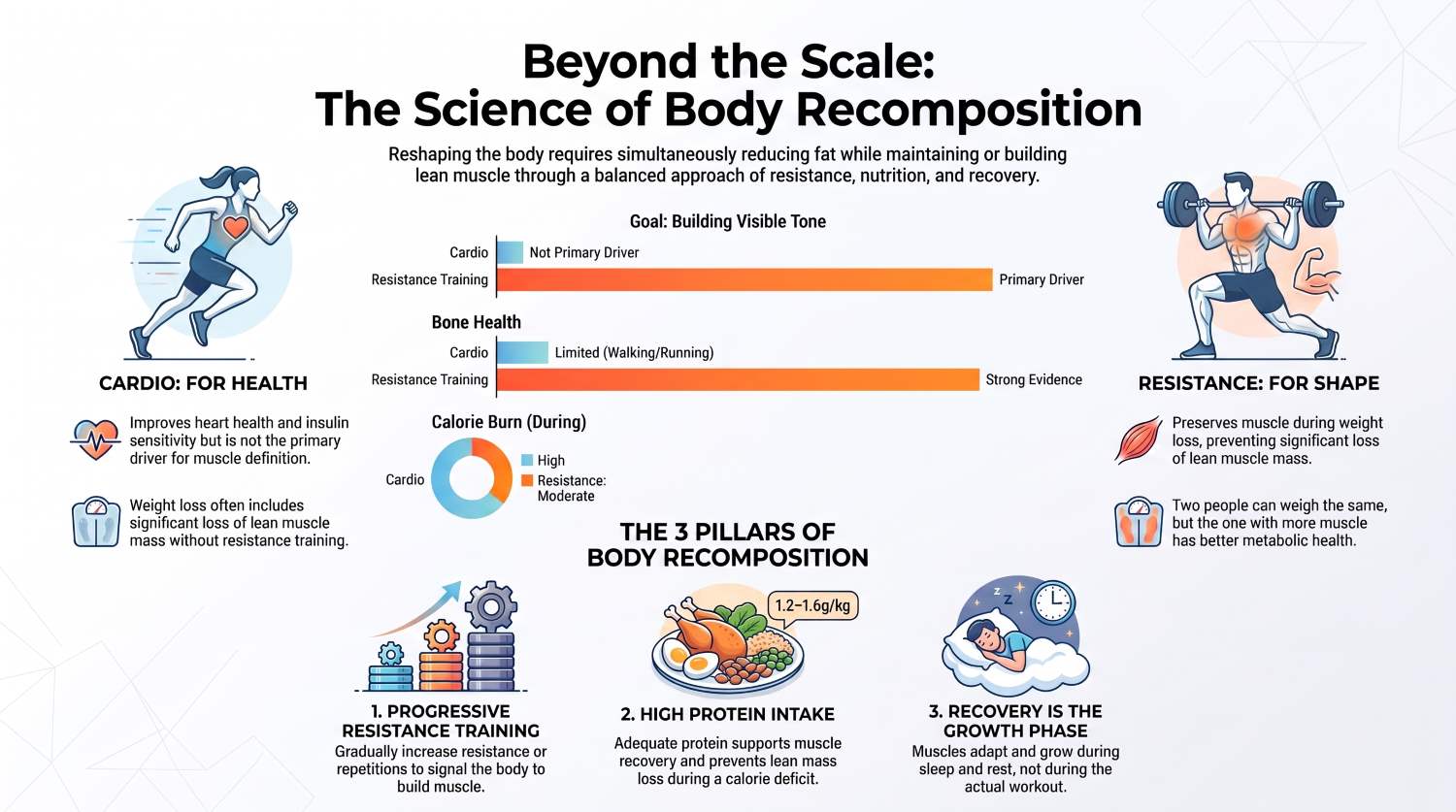
| Goal | Cardio | Resistance Training |
|---|---|---|
| Heart & cardiovascular health | ✅ Strong evidence | ⚠️ Some benefit |
| Insulin sensitivity | ✅ Strong evidence | ✅ Strong evidence |
| Calorie burn during activity | ✅ High | ⚠️ Moderate |
| Muscle preservation during weight loss | ⚠️ Limited | ✅ Strong evidence |
| Building visible tone (muscle definition) | ❌ Not primary driver | ✅ Primary driver |
| Reshaping body composition | ⚠️ Supportive | ✅ Primary driver |
| Bone health | ⚠️ Weight-bearing cardio only (walking, running, stairs) | ✅ Strong evidence |
| Best approach for most people | Combining BOTH (concurrent training) | |
The research is clear that combining both types of training — often called concurrent training — tends to produce the best overall body-composition outcomes for most people. Cardio isn’t the enemy. It just may not be the whole answer.
Doing Cardio but Not Seeing Body Changes?
Hannah’s coaching combines strength training with general nutrition education — with referrals to a registered dietitian or physician when individualized medical nutrition therapy is needed.
The Three Pillars of Body Recomposition
Reviews across the strength and conditioning literature consistently point to three factors that drive body recomposition:
Pillar 1: Progressive Resistance Training
Strength training is the primary signal for your body to preserve muscle during weight loss and to build new muscle over time. This can include free weights, machines, resistance bands, or bodyweight movements. The key element is progression — gradually challenging your muscles over time by increasing resistance, repetitions, or complexity.
Pillar 2: Adequate Protein and Overall Nutrition
Protein intake supports muscle recovery, satiety, and lean-mass preservation. Research reviews on body composition frequently reference protein ranges around 1.2–1.6 grams per kilogram of body weight per day for active adults during weight loss — though appropriate targets vary by body size, age, health, calorie intake, and activity level. Individualized targets should come from a registered dietitian or qualified healthcare professional, especially for people with kidney conditions or other medical concerns.
Pillar 3: Recovery, Sleep, and Consistency
Muscle grows and adapts during recovery — not during the workout itself. Consistent sleep, stress management, and a sustainable training schedule support the adaptations that make body recomposition possible. Research also notes that short sleep is associated with changes in appetite regulation and may make body-composition goals more difficult.
What a Balanced Weekly Approach Might Look Like
Every person is different, but a common evidence-supported framework for body recomposition includes both resistance training and cardio in complementary roles:
- 🏋️Resistance training: 2–3 sessions per week targeting major muscle groups
- 🚶Zone 2 / low-intensity cardio: Walking, easy cycling, or similar; Zone 2 refers to moderate-intensity exercise where you can still carry on a conversation. It supports cardiovascular health without interfering with strength adaptations.
- 💥Optional higher-intensity cardio: One shorter session per week for cardiovascular fitness, if desired
- 🥩Adequate protein: Individualized target based on your body, activity, and goals
- 😴Consistent sleep: Supports recovery, appetite regulation, and adherence
- 📈Progressive training: Gradually increasing challenge over weeks and months
This is a general framework, not a prescription. The right structure depends on your current fitness, schedule, health status, and goals — which is exactly what a coach helps you design.
Common Mistakes People Make When Cardio Isn’t Working
- Doing more cardio. When cardio-only isn’t producing body-shape changes, adding more cardio usually isn’t the answer. Adding resistance training and reassessing nutrition typically produces better outcomes.
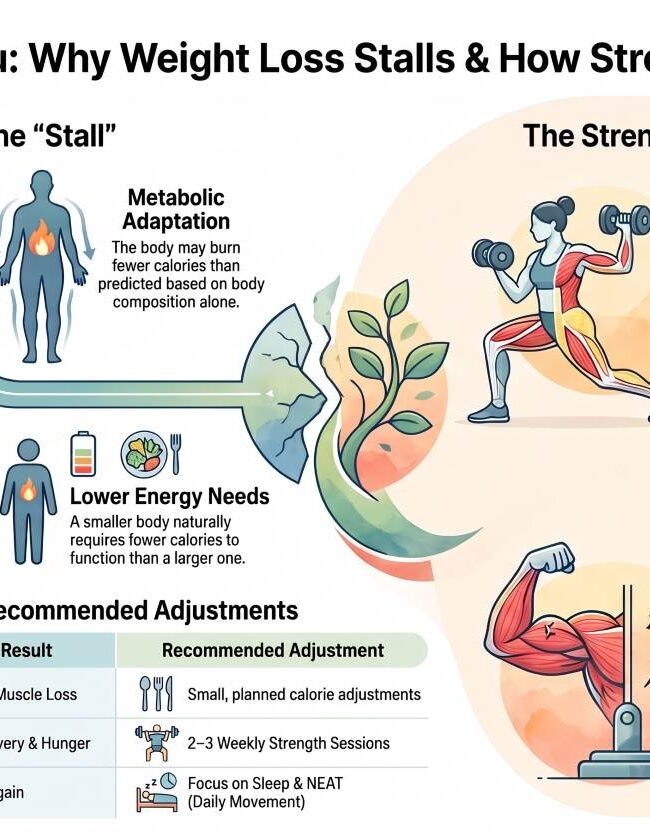
- Under-eating. Very aggressive calorie cuts can increase hunger, reduce training quality, and make lean-mass preservation harder. A more moderate approach usually works better.
- Skipping protein. Insufficient protein makes muscle preservation during weight loss more difficult.
- Same workout for months. Progressive challenge matters. Doing the same routine indefinitely may lead to reduced training adaptation.
- Chasing the scale only. Body recomposition can improve how you look, feel, and function even when the scale doesn’t move much. Measurements, strength, and how clothes fit tell a fuller story.
Who Benefits Most from Adding Strength Training
- People who are already doing cardio consistently. Adding resistance training tends to produce visible changes cardio alone often can’t.
- Adults 40+. Age-related changes make muscle preservation more important — and strength training is the most consistently supported way to address it.
- Women in perimenopause and menopause. Menopause is associated with changes in body composition, and resistance training may support strength and function during this phase of life. See Hannah’s menopause coaching for more.
- People on GLP-1 medications. Some lean mass is commonly lost during medication-assisted weight loss; resistance training may help preserve muscle and physical function. Coordinate with your prescribing physician.
- Anyone wanting visible muscle definition. “Toning” is really a combination of losing fat and having enough muscle to define the shape underneath. Available across Syosset, Plainview, and surrounding areas.
Cardio vs. Strength Training: Quick Answers
Is cardio better for fat loss?
Cardio produces a higher calorie burn during activity, which can support a calorie deficit and fat loss. However, cardio alone does not strongly signal the body to preserve or build muscle, which affects how the fat loss actually looks. Combining cardio with resistance training and adequate protein tends to produce better fat-loss outcomes in terms of both amount and body composition.
Is strength training better for building muscle?
Yes. Progressive resistance training is the most consistently supported way to build and preserve muscle mass, based on decades of research across age groups and fitness levels. Cardio does not provide the same muscle-building stimulus, though certain forms of cardio can support cardiovascular fitness alongside strength work.
Which is better for body recomposition?
Resistance training is the primary driver of body recomposition — losing fat while preserving or building muscle. However, the strongest evidence supports concurrent training: combining resistance training and cardio, alongside adequate protein and sleep. This is also the approach recommended by the American College of Sports Medicine (ACSM).
Frequently Asked Questions
1. Should I stop doing cardio?
No. Cardio has genuine, well-documented benefits for heart health, endurance, and general wellness. The point isn’t to abandon cardio — it’s to add resistance training so your body has the tools to actually reshape.
2. How quickly will I see body composition change?
Timelines vary considerably by person, starting point, consistency, and other factors. Some people notice changes in measurements, strength, or how clothes fit within several weeks; others need longer.
3. Will strength training make me bulky?
Building large amounts of muscle typically requires very specific, high-volume training combined with a calorie surplus. Most people doing 2–3 sessions per week for body recomposition build a lean, toned appearance rather than a “bulky” one.
4. Do I need heavy weights?
Not necessarily. Body recomposition can be supported with dumbbells, resistance bands, bodyweight movements, and appropriately progressive loads. The right choice depends on your body, experience, and goals.
5. How is body recomposition different from just losing weight?
Weight loss can include loss of fat, muscle, water, or other tissues. Body recomposition specifically focuses on reducing fat while preserving or building lean mass — often producing better strength, function, and appearance for the same or even similar body weight.
6. Does Hannah provide meal plans or calorie targets?
Hannah provides general nutrition education and habit-based coaching within a personal trainer’s professional scope. For individualized medical nutrition therapy, meal plans, or specific calorie prescriptions — especially if you have a medical condition — she refers clients to a registered dietitian.
7. I’m over 60. Is this too late for me?
Research supports that adults across a wide range of ages can improve body composition, strength, and function with appropriate resistance training. Individual results vary based on health status, consistency, and other factors.
Key Takeaways
- • Cardio supports heart health, insulin sensitivity, endurance, and mental health.
- • Resistance training is the primary driver of muscle preservation and body recomposition.
- • Adequate protein intake supports lean-mass preservation during weight loss.
- • Sleep, recovery, and consistency affect appetite regulation and training adaptations.
- • Combining cardio and strength training (concurrent training) produces the strongest overall results for body recomposition.
The Bottom Line
Cardio isn’t the problem — it’s a valuable part of a balanced fitness program. But if your goal is to change your body composition — less fat, more strength, more visible tone — the research consistently points to resistance training combined with adequate nutrition, protein, sleep, and consistency as the more complete approach. A personalized plan built around all of these components, rather than any single one, tends to produce the most sustainable results.
Ready to Add Strength to Your Routine?
Serving Syosset, Plainview, Woodbury, Old Westbury, Muttontown, Jericho, Melville & Farmingdale
Certified Personal Trainer | In-Home Coaching | Strength Training & General Nutrition Education
Call: 516-254-9873 | Email: eurofit36@gmail.com
Sources & References
- Resistance training as a key strategy for high-quality weight loss in men and women. Frontiers in Endocrinology. 2025. (RT group gained fat-free mass while reducing fat mass — indicating body recomposition — compared to aerobic-only and no-exercise groups.) frontiersin.org — DOI: 10.3389/fendo.2025.1725500
- Barakat C., Pearson J., Escalante G., Campbell B., De Souza E.O. Body Recomposition: Can Trained Individuals Build Muscle and Lose Fat at the Same Time? Strength and Conditioning Journal (National Strength and Conditioning Association). 2020;42(5):7–21. (Review of body recomposition evidence including concurrent training.) journals.lww.com/nsca-scj
- Cleveland Clinic. What to Know About Body Recomposition. 2024. (Patient-education article covering evidence-informed body-recomposition strategies.) health.clevelandclinic.org/body-recomposition
- Systematic review and meta-analysis on the effect of resistance exercise on body composition, muscle strength, and cardiometabolic health during dietary weight loss. British Journal of Sports Medicine / PubMed Central. (Resistance exercise added to weight loss programs produces greater fat loss and lean-mass preservation.) PMC12406911
- Westcott W.L. Resistance Training is Medicine: Effects of Strength Training on Health. Current Sports Medicine Reports. 2012 Jul-Aug;11(4):209–216. (Narrative review summarizing prior research on resistance training and body composition.) pubmed.ncbi.nlm.nih.gov/22777332
- Sarwan G., Rehman A. Management of Weight Loss Plateau. StatPearls [Internet]. NCBI Bookshelf. (Clinical overview of contributing factors and individualized management strategies.) ncbi.nlm.nih.gov/books/NBK576400
- American College of Sports Medicine. Position Stand: Progression Models in Resistance Training for Healthy Adults. Medicine & Science in Sports & Exercise. 2009;41(3):687–708. (Foundational ACSM guidance on progressive resistance training program design — one of the most cited references on progressive overload.) journals.lww.com/acsm-msse
- Jäger R., Kerksick C.M., Campbell B.I., et al. International Society of Sports Nutrition Position Stand: Protein and Exercise. Journal of the International Society of Sports Nutrition. 2017;14:20. (One of the most authoritative and widely-cited nutrition references on protein intake for exercising adults.) jissn.biomedcentral.com
- American College of Sports Medicine / American Heart Association. Physical activity guidelines and recommendations for adults, including both aerobic and muscle-strengthening activity.
- U.S. Department of Health and Human Services. Physical Activity Guidelines for Americans. health.gov/paguidelines
Note: Where article statements refer to certifications, client experience, or program outcomes, those specific claims are attributable to Hannah’s practice and are not derived from the sources above.